Home Safran Recipe
Recipe collection · Culinary intelligence
Safran de Taliouine

A chef’s field guide to Category I Taliouine saffron: how to unlock its perfume, understand its singular flavor architecture, and bring the red gold of the Anti-Atlas into classical and forward-looking kitchens.

05
Frontier recipes
70–75°C
Bloom window
✦
A culinary study of Taliouine’s red gold
Flavor architecture & the bloom protocols
Release the perfume before it meets the plate

Taliouine saffron is less an ingredient to add than an aromatic system to unlock.

The CIA standard bloom protocol

“The aromatic volatiles in Taliouine saffron are locked in glycoside form until moisture, heat, or acid cleaves the molecular bond. This is why raw saffron placed on the tongue communicates little, so it must be bloomed. The CIA standard bloom protocol for Category I saffron is as follows: pinch threads gently into a small vessel; add four to six times the volume of warm liquid at 70–75°C (above this temperature, key volatile compounds including safranal begin to degrade); allow 15–30 minutes minimum, two to four hours optimal. The bloom liquid itself becomes a concentrated saffron extract of extraordinary potency. One gram of Category I Taliouine saffron, properly bloomed, can color and flavor approximately 600–800 ml of liquid.”

01
Pinch
Gently open the threads in a small vessel.
02
Hydrate

Add four to six times their volume of liquid at 70–75°C.

03
Wait

Bloom 15–30 minutes minimum; two to four hours is optimal.

✦
The bloom liquid becomes a concentrated aromatic extract
✦
Cold-preserved volatiles release at
mouth temperature
Saffron ice bloom method
For preparations where heat never arrives

“For raw and cold-finished preparations where no subsequent heat will develop the saffron further: crudo, ceviche, and cold leche de tigre; vinaigrettes and cold emulsions; cocktail syrups and shrubs; cold-process saffron honey; chilled saffron labneh and yogurt dressings. Frozen bases where the bloom goes directly into ice cream, semifreddo, or granita, where the cold-preserved volatiles release at mouth temperature for maximum aromatic impact. High-clarity visual applications requiring a clean, translucent saffron liquid: aspic, clear consommé gilding, saffron gels, and cold-set presentations where turbidity would compromise the plate.”
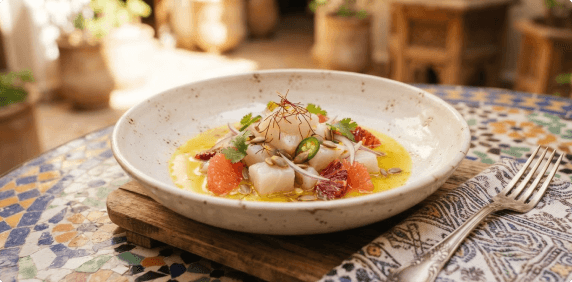
Crudo & ceviche
Cold emulsions
Frozen bases
Clear gels
Shrubs
Three primary compounds
Color, bitterness, perfume—and a mineral fourth note

“The three primary flavor compounds each contribute a distinct dimension: crocin delivers color and the initial sweet, honey-like note; picrocrocin delivers the characteristic bitter-herbal sharpness; safranal provides the unmistakable perfumed, hay-like aroma. Premium Taliouine saffron achieves an exceptional balance of all three, and the mineral quality of the Anti-Atlas terroir contributes an iodine-mineral fourth note that clearly distinguishes it from Kashmiri, Iranian, or Spanish varieties.”

Crocin
Color & sweetness

The first golden bloom and a sweet, honey-like opening note.

Picrocrocin
Bitter-herbal structure

A clean, characteristic sharpness that gives the spice its contour.

Safranal
Perfume & lift
The unmistakable hay-like aroma that rises above the plate.
Anti-Atlas
Mineral fourth note
An iodine-mineral signature unique to the Taliouine terroir.
Current established uses
A classical vocabulary spanning Morocco and Europe

The familiar canon, from onion-butter tagine bases to luminous custards and laminated dough.

Traditional & Classical Applications
  • Moroccan chicken and lamb tagines, typically bloomed in onion-butter base
  • Harira and bissara soup enrichment
  • M’hanncha and bastilla pastry gilding
  • Moroccan wedding couscous, saffron-butter sauce
  • Rfissa, saffron and fenugreek chicken over shredded m’semen bread
European Classical Applications
  • Bouillabaisse and Provençal fish soups
  • Saffron risotto alla Milanese (Risotto di Zafferano)
  • Paella Valenciana and arroz negro
  • Sauce Dieppoise and classical French court-bouillon for shellfish
  • Saffron pasta (bigoli, pappardelle, fettuccine)
  • Swedish saffron buns (Lussekatter) — a Category I saffron dramatically elevates this preparation
Pastry & Confection (Established)
  • Saffron panna cotta and crème brûlée
  • Saffron ice cream and semifreddo
  • Saffron-orange cake and pound cake
New & forward applications
Frontier proposals for the modern pantry

Five techniques designed around saffron’s temperature, aromatic volatility, mineral register, and remarkable affinity for citrus, butter, fermentation, and umami.

01
Cold, Raw & Cured
SAFFRON CEVICHE LECHE DE TIGRE
‘Tigre del Atlas’
Concept

“Taliouine saffron bloomed in citrus juice becomes the base for the most aromatic leche de tigre in modern Latin-Moroccan fusion. The mineral-iodine note of the saffron functions identically to the oceanic quality a classical Peruvian chef achieves with fish stock, only here it is pure terroir.”

02
Pastry Frontier
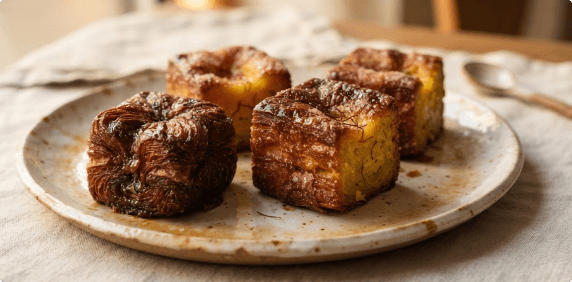
TALIOUINE SAFFRON KOUIGN-AMANN
‘Kouign de l’Atlas’
Concept

“The Breton butter cake meets Moroccan saffron. Category I saffron infused into the caramelized butter layers of a kouign-amann produces a laminated pastry of extraordinary perfume. The layers reveal saffron’s honey-floral note against the bitter caramel in a progression no other spice could achieve.”

03
Savory Modern: Protein & Umami
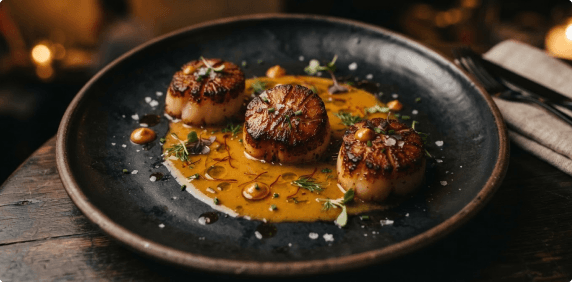
SAFFRON-BLOOMED SEA SCALLOPS
‘Coquilles de Mogador’
Concept

“A brief 10-minute dry-brine paired with a quick saffron-infused emulsion, where dry-packed sea scallops are hard-seared at high heat to achieve a deep mahogany crust while keeping the center sweet and translucent. Finished off-heat with culinary argan oil to preserve its volatile, toasted-nut aromatics without scorching. Service over a warm saffron-butter reduction.”

04
Savory Modern: Protein & Umami
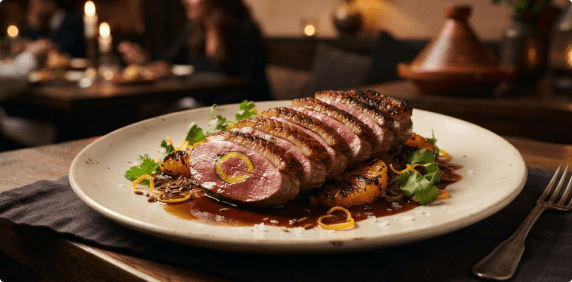
SAFFRON-BRINED DRY-AGED DUCK BREAST
‘Canard de l’Atlas’
Concept

“A wet-brine of saffron, orange, and cumin used over 48 hours on Moulard duck breast before a 5-day pellicle dry-age under refrigeration. The saffron pigment penetrates 3–4mm into the flesh, creating a golden aureole visible in the cross-section. Service with argan jus.”

05
Beverage Frontier
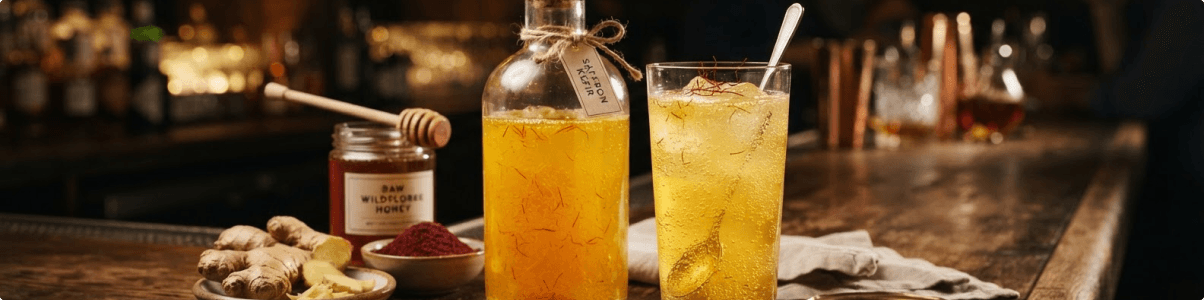
TALIOUINE SAFFRON KEFIR SHRUB / Functional Culinary Vinegar
Concept

“A slow-fermented apple cider vinegar shrub where Taliouine saffron is steeped during a 72-hour maceration with fresh ginger, sumac, and wildflower honey. The result is a nutraceutical-grade culinary vinegar that functions as a drinking shrub, cocktail modifier, or salad dressing acid.”